Neuroscience 2026 – SEALS Phase 2 clinical trial in patients with ALS
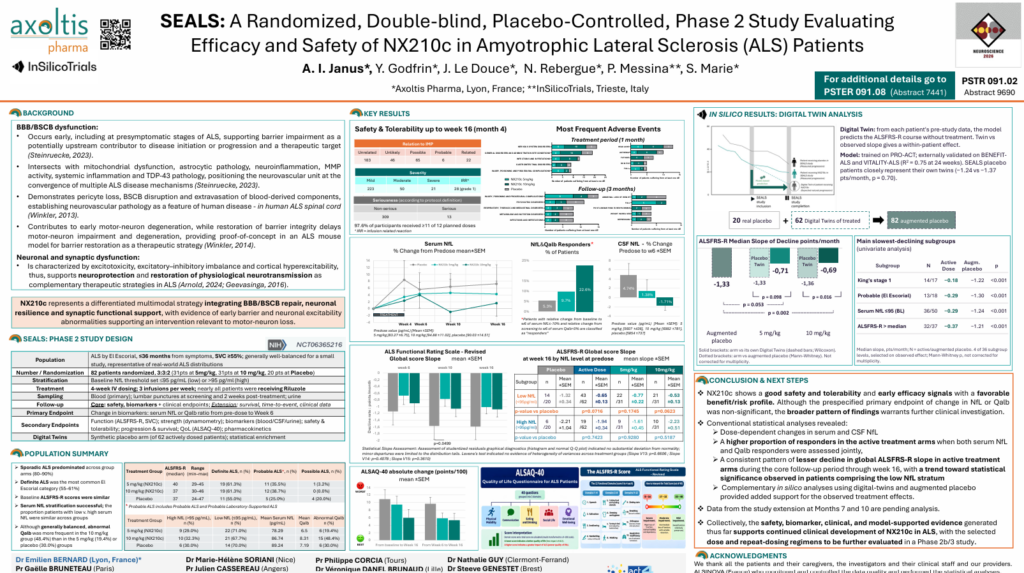
SEALS: A Randomized, Double-Blind, Placebo-Controlled Phase 2 Study Evaluating Efficacy And Safety Of NX210c In Amyotrophic Lateral Sclerosis (ALS) Patients
A. I. JANUS1, S. MARIE1, J. LE DOUCE1, N. REBERGUE1, P. MESSINA2, Y. GODFRIN1; 1Axoltis Pharma, Lyon, France; 2InSilicoTrials, Trieste, Italy
Objectives
NX210c is a chemically synthesized Thrombospondin type 1 repeat (TSR1) analog that demonstrates blood brain barrier (BBB) integrity restorative capacity by increasing the dominant tight junction protein expressed on neurovascular endothelium (claudin-5), exhibits neuroprotective properties and neurotransmission enhancement. Combining these properties, NX210c is a promising drug candidate for several CNS diseases including ALS.
Material and methods
The SEALS Phase 2 clinical trial (NCT 06365216) investigated biomarkers and clinical outcomes in 82 ALS patients randomized and dosed 3-times per week for 4 weeks with intravenous infusion of NX210c at 5, 10 mg/kg or placebo in a 3:3:2 ratio, also stratified by serum neurofilament light (NfL), a prognostic biomarker of disease activity. A core study followed patients for 3 months thereafter. Primary endpoints included NfL or Qalb (Quotient of albumin conc. in CSF/Blood) changes. Secondary endpoints expanded the analysis of safety, pharmacokinetics and clinical (e.g. Harmonized ALSFRS-R score, Handheld Dynamometry (HHD)) and blood, CSF, urine biomarker indicators.
Results
The safety and tolerability profile of NX210c was good. The half-life of NX210c was 17 min. and no accumulation in the blood as previously observed in healthy volunteers. A dose dependent trend to NfL changes was observed at 4 and 6 weeks and a subgroup of patients decreasing NfL by more than 10% and combined with a Qalb decrease was identified. The slope of ALSFRS-R score calculated from baseline to week 6 was reduced by 0.47 (5mg/kg) and 0.24 points/month (10mg/kg) compared to placebo, mainly due to motor scores. At week 4, at 5mg/kg about 30% of the patients improved or stabilized their HHD in left and right elbow, wrist, knee, and ankle. The up coming 3-month follow up results will be presented during the convention.
Conclusion
According to the preliminary positive signal of effect, NX210c is a drug candidate with combined properties relevant to play a significant role in the treatment of ALS patients. Based on SEALS results, in silico modeling will be able to profile the responders and to determine the optimized dose and regimen for next clinical development milestones.