
ASIA – American Spinal Injury Association 2021
St Louis – Missouri USA
SCO-spondin derived peptide promotes functional recovery in a mouse model of spinal cord injury
Alexandra H. Lopez1, Sighild Lemarchant2, Theresa C. Sutherland1, Lily Kuhlman1, Ana Matthews1, Kristina Reppond1, Nathalie Delétage2, Juliette Le Douce2, Manuel Blanc2, Yann Godfrin2,3, Cédric G. Geoffroy1
1Department of Neuroscience and Experimental Therapeutics, Texas A&M Health Science Center, Bryan, TX, USA
2Axoltis Pharma, Lyon, France
3Godfrin Life Sciences, Caluire, France
Introduction
The subcommissural (SCO)-spondin is a brain-specific glycoprotein produced by the SCO organ expressed throughout development, that strongly contributes to axon growth. This organ becomes atrophic in adults, thereby losing regenerative functions of damaged nervous cells. Using a mouse hemisection model of spinal cord injury, we have evaluated the therapeutic effect of a NX peptide (Axoltis Pharma – France), an innovative drug candidate derived from the SCO-spondin protein.
Methods
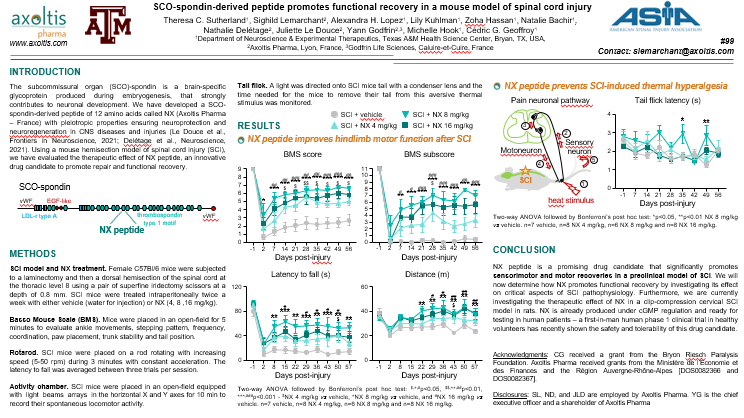
Adult female mice were subjected to a laminectomy at the thoracic vertebrae number 8 (T8) and the dorsal part of the spinal cord was cut with superfine scissors. Mice were treated with NX peptide at 4, 8 or 16 mg/kg. Hindlimb functional recovery was assessed once a week up to 8 weeks post-injury using the Basso Mouse Scale (BMS) score and subscore, the rotarod and activity chamber tests. Mice were sacrificed at 73 days post-injury (dpi), and the spinal cords were collected for immunohistochemistry.
Results
Treatment with NX peptide (8 mg/kg) significantly improved the BMS score from 2 to 56 dpi (3/9 for the vehicle group, 7/9 for the NX group at 56 dpi). Indeed, while untreated injured mice did not display plantar stepping, NX peptide-treated injured mice presented frequent to consistent plantar stepping and coordination as early as 21 dpi. Similarly, the BMS subscore was also increased from 7 to 56 dpi (0/11 for the vehicle group, 7/11 for the NX group at 56 dpi). The latency to fall from the rotarod was also increased by NX peptide from 8 to 57 dpi (15 s for the vehicle group, 54 s for the NX group at 57 dpi). NX peptide administrations increased spontaneous locomotor activity in the activity chamber test, including the total distance traveled from 22 to 57 dpi (23 m for the vehicle group, 37 m for the NX group at 57 dpi). In addition to the therapeutic effect of NX peptide on locomotion, analysis of pain using the tail flick test revealed that SCI-induced pain hypersensitivity was relieved by NX peptide at 35 and 49 dpi. Histological analysis is ongoing to understand the underlying cellular responses.
Conclusions In conclusion, NX peptide is a promising drug-candidate that significantly promotes sensorimotor and motor recoveries in a preclinical model of spinal cord injury. Besides proof of concepts in other animal models, in vitro and in vivo experiments are also under investigation to precise the mechanism of action of NX peptide. A phase 1 clinical trial in healthy volunteers is ongoing to evaluate tolerability of NX peptide.